

How Schools Should Choose Between Google, Meta, CTV & Programmatic (Without Wasting Budget)

“What’s the best advertising platform for our school?”
It is one of the most common questions school leaders ask when evaluating digital marketing.
It is also the wrong place to start.
There is no universally “best” platform. Google, Meta, Connected TV, and programmatic advertising all work, but they work differently. The real question is not which platform is strongest. It is which platform aligns with your school’s goals, budget, timeline, and audience behavior.
Schools waste budget when they choose channels before defining the role advertising should play in their enrollment strategy.
A smarter approach is to evaluate platforms through four decision filters.
The 4 Decision Filters
1. Budget Size:
Budget determines how broad your strategy can be.
Smaller budgets are typically best allocated toward high-intent channels like Google Search, where families are already actively looking.
Mid-range budgets allow for layering search with Meta retargeting to stay in front of families who have visited your website.
Larger budgets make it possible to invest in awareness channels like CTV and programmatic to strengthen long-term visibility.
Trying to be everywhere with limited spend often leads to diluted results.
2. Enrollment Timeline (Immediate vs Long-Term)
Advertising must match your admissions calendar.
If you need inquiries quickly, prioritize high-intent platforms such as Google Search or Meta Leads campaigning.
If you are building next year’s pipeline or entering a more competitive market, awareness channels like Meta prospecting, CTV, and programmatic become more important.
Short-term urgency and long-term brand positioning require different channel priorities.
3. Audience Intent Level
Not all prospective families are at the same stage of readiness.
High intent: Families actively searching and comparing schools. Best captured through Google Search.
Mid intent: Families researching options but not yet committed. Best supported through retargeting campaigns.
Low intent: Families who fit your demographic profile but are not yet searching. Best reached through Meta prospecting, CTV, and programmatic.
Strong enrollment strategies connect awareness, nurture, and conversion rather than relying on one stage alone.
4. Brand Awareness vs Lead Generation Goal
Lead generation and brand awareness are different objectives.
Lead generation platforms (Google Search, Performance Max, Meta retargeting) are designed to drive direct inquiries.
Brand awareness platforms (CTV, programmatic video, Meta prospecting) build familiarity and trust, which improves long-term performance.
In competitive markets, brand strength lowers future cost per lead. Ignoring awareness can make acquisition more expensive over time.
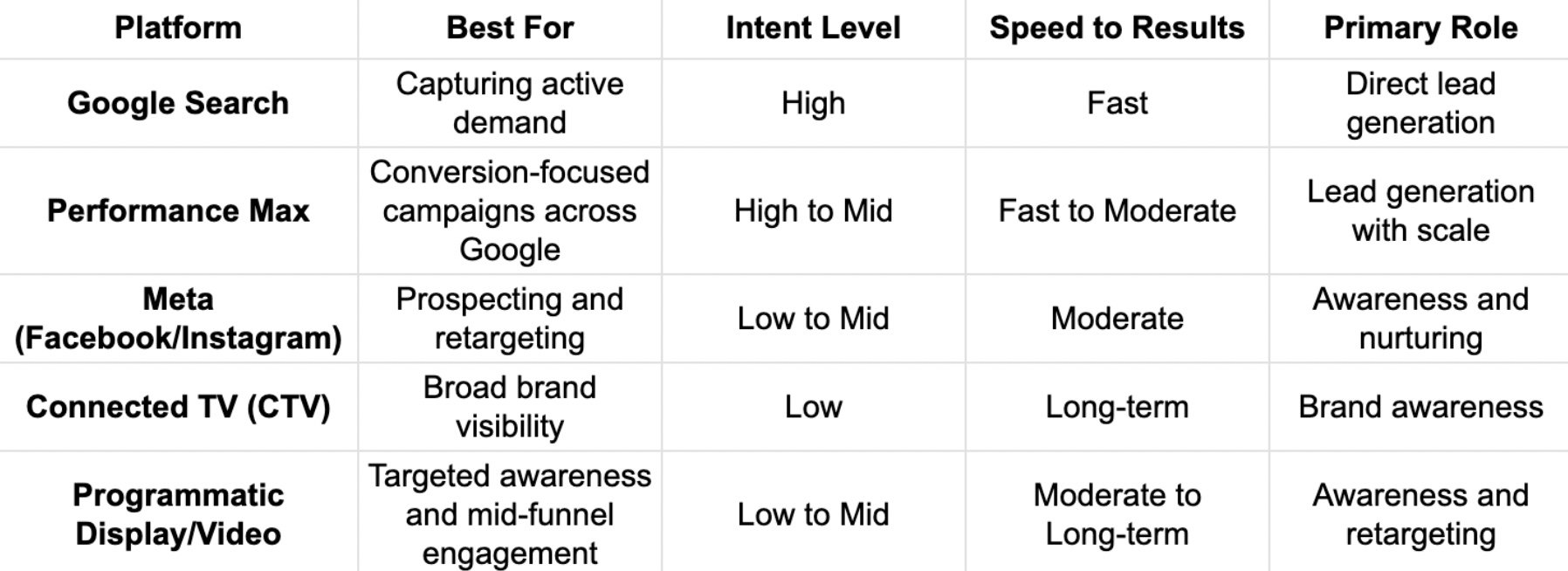
Quick Comparison of Major Advertising Channels
Final Thought
The most successful schools do not start with, “Should we try Meta?” or “Is Google still working?”
They start with:
What role should advertising play in our enrollment strategy this year?
Once that is defined, platform selection becomes clear.
Advertising should feel aligned and intentional, not experimental.
If your team is evaluating where to invest next, Schoolcraft Digital can help you think through the right channel mix based on your enrollment goals, budget, and market position.
Schedule a free 30 minute consultation with our team to discuss your current strategy and explore where your advertising dollars can work harder.
