

How Independent Schools Should Use Google Search and Google Ads for Enrollment
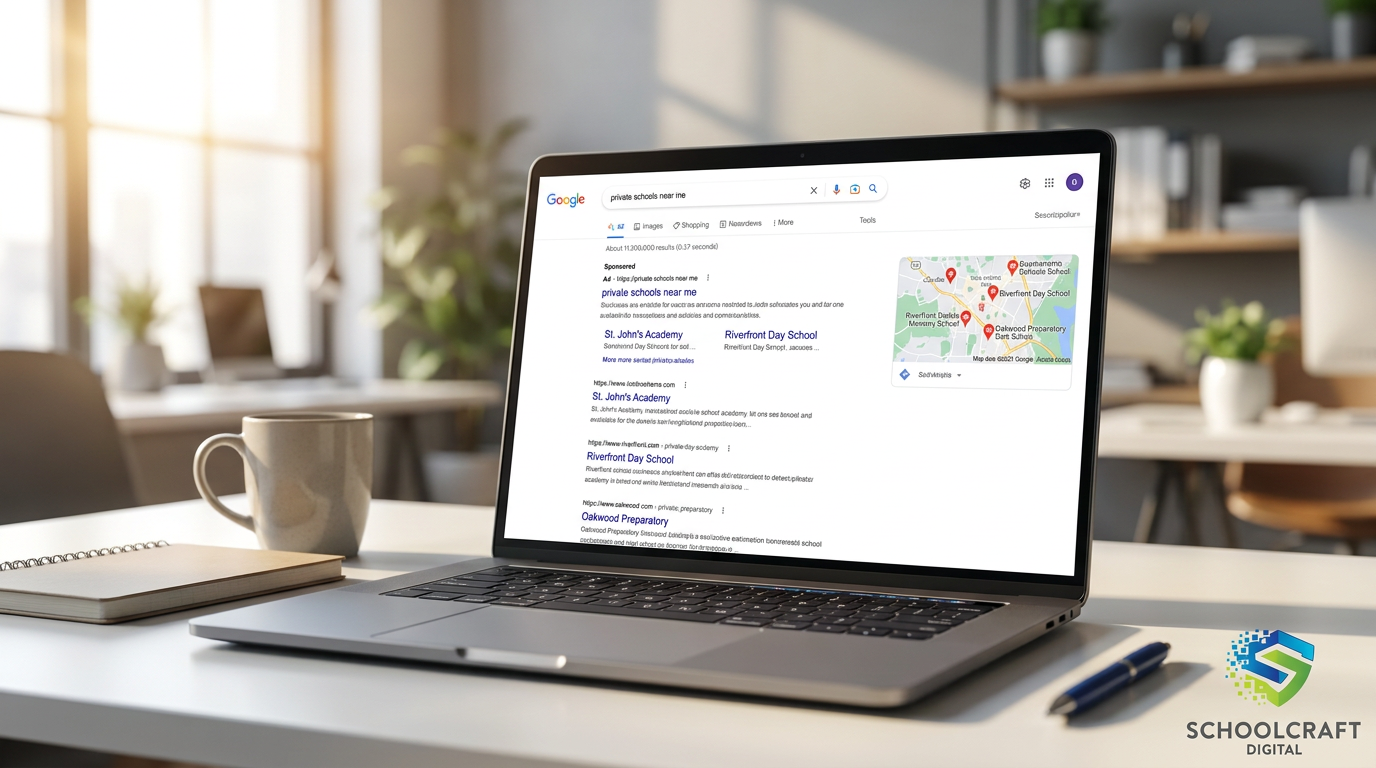
Most families do not begin their school search with a specific school in mind. They begin with Google.
Searches like “private schools near me” or “best elementary schools in [city]” determine which schools are seen first. Google then displays a set of results, typically a mix of ads, local listings, and website pages.
Those initial results shape which schools are explored.
If your school does not appear in those results, it is less likely to be included in early comparisons.
The Visibility Gap Most Schools Don’t See
Many independent schools appear in search results for their own name. That visibility happens late.
Branded search captures families who already know your school exists. It does not influence which schools are discovered in the first place.
Non branded searches happen earlier. This is when families are comparing school types, programs, and locations. The schools that appear in these searches are the ones that get evaluated.
If your school is not visible at this stage, it is less likely to be included in the first round of consideration.
What Determines Whether Your School Shows Up
Google ranks individual pages and business listings, not institutions as a whole.
Search results are based on how well a page or listing matches a specific query. For local searches, proximity and the completeness of business information also influence what appears.
This creates a clear requirement. Your website and business profile need to reflect how families actually search. If that connection is not clear, your pages are less likely to appear for relevant searches.
How Website Structure Impacts Search Visibility
Many schools rely too heavily on their homepage to represent everything.
A homepage is designed to introduce the school. It provides a general overview, but it is not built to answer specific questions about programs, tuition, or grade levels.
Google matches search queries to individual pages. When a school does not have clear, focused pages for key topics, it becomes more difficult for those pages to appear in relevant searches.
For example, if a family searches for “private elementary school in [city]” and the only relevant page is a general homepage, the connection between the search and the content is limited.
A more effective approach is to structure your website around the topics families are actively researching.
This typically includes:
Pages for each division, such as Lower School, Middle School, or Upper School
Pages that explain academics or curriculum
Pages that clearly outline tuition and the admissions process
Content that answers common questions families have during their research
Page titles, headings, and content should reflect how families search, including location where relevant.
This structure makes it easier for Google to understand when your pages are relevant and makes it easier for families to find the information they are looking for.
Where Google Ads Fit
Google Ads allows your school to appear in search results for specific queries through paid placement. This is most valuable in non branded searches, where families are actively comparing options.
Many schools limit ads to their own name. That protects branded traffic, but it does not expand discovery. A stronger approach focuses on the searches that define the consideration set.
This includes:
“private schools near me”
“best private schools in [city]”
“private schools with strong academics”
These are the moments when families are deciding which schools to evaluate. Effective campaigns align three elements:
The search query
The ad message
The page the user lands on
When these are aligned, it is easier for families to find relevant information and take the next step. Google Ads also provides direct insight into what families are searching, which can be used to improve website content and messaging.
The Role of Google Business Profile
For local search results, Google Business Profile plays a significant role. Google uses this information to understand and display local organizations.
A complete and accurate profile includes:
Correct contact information
Updated hours and details
Relevant categories
Photos and current information
Incomplete or outdated profiles can limit how clearly Google understands and presents your school in local results.
A More Strategic Approach
Google should be approached as an active channel, not a passive outcome.
A practical starting point:
Identify common non branded searches related to your school and location by reviewing Google search suggestions and existing website traffic
Ensure your website has pages that directly match those searches, particularly for divisions, programs, and admissions topics
Use Google Ads to appear in high intent search results where families are actively comparing schools
Send users to pages that match the search topic, rather than directing all traffic to the homepage
Maintain a complete and accurate Google Business Profile with updated information and current visuals
Start with a small set of high priority searches and build from there. Clarity and alignment are more effective than trying to cover everything at once.
Final Thought
Google Search is a primary way families gather information when evaluating schools. Visibility in those results depends on how well your content, listings, and advertising align with how people search. Schools that make that alignment clearer are more likely to appear in relevant searches and be included in early stage research.
At Schoolcraft Digital, we help independent schools build enrollment focused strategies across search, social, and video, ensuring your school is visible where families are actively researching options.
If your school is not appearing in non branded search results, your visibility is limited to families who already know your name.
Schedule a free 30 minute consultation: schoolcraftdigital.com/contact-us
